Sedges (Carex, Cyperus (Umbrella Sedge), Eleocharis (Spike Rush), Schoenoplectus
(Naked Stem Bulrush), Perigynium, Tubercle)
By Bruce Homer-Smith
Sedges
have edges – most sedges have
triangular stems. If you run your hand
along the stem, you can feel the three edges.
Occasionally, a sedge stem will have four edges or be round. Stems are solid (filled with pith) and erect.
Here are some other sedge characters:
·
They’re
often found in bogs, swamps or meadows along streams.
·
Sedges generally have
long, quite narrow leaves.
·
Inflorescences vary, as you’ll see below. In California, all sedges are wind
pollinated.
·
Sedge flowers do not
have petals (rushes do).
California has seven
genera of sedges. Here’s how to
distinguish between the major ones.
Carex
Carex is the most
common sedge genus. Separate male and
female flowers appear on the same plant, sometimes on the same spike and
sometimes on different ones. Stems are
triangular in cross section.
|
Photo by
Steve Matson |
Photo by
Steve Matson |
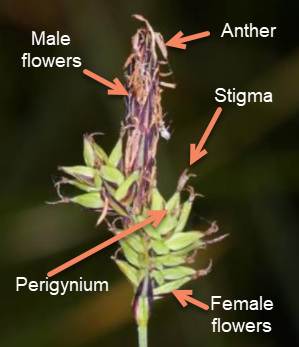
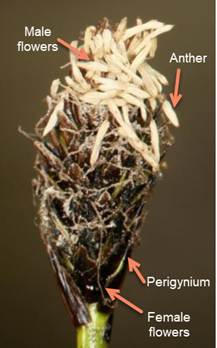
Carex female flowers
have a perigynium - a hard sac that
completely surrounds the pistil except for a pore at the top, which allows the
stigma to stick out so it can receive pollen.
If you find this structure, you know you’re looking at a Carex.
Cyperus – Umbrella Sedges
Cyperus flowers are
generally bisexual. They don’t have a
perigynium or tubercle.
Stems are triangular or round in cross section.
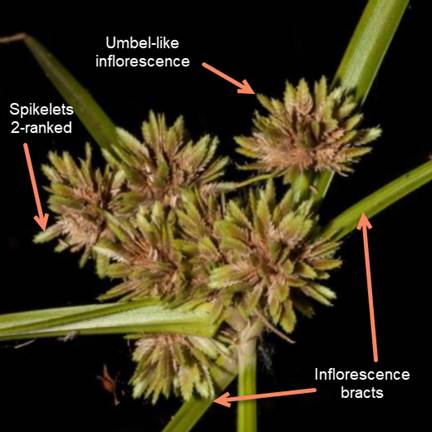
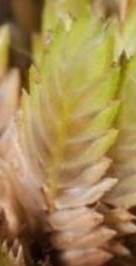
Tall Flatsedge (Cyperus eragrostis)
Photos by Wilde
Legard
Cyperus inflorescences are umbel-like. In Tall Flatsedge,
above, a large umbel has flat leaf-like bracts that point sideways. Secondary
umbels are made up of two-ranked spikelets.
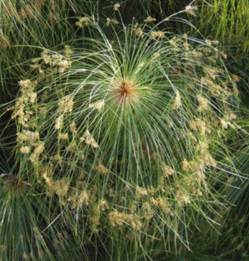
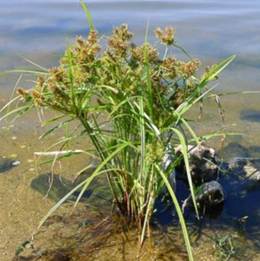
Here are two other
species of Cyperus, also showing the
umbel organization and flat groupings of spikelets.
|
Photo by Ron
Vanderhoff |
Photo by
Steve Matson |
Eleocharis – Spike Rushes
Eleocharis is derived
from two Greek words meaning “graceful marsh dweller”.
This sedge is
confusing – it has “rush” in its common name and has round stems, but it is not
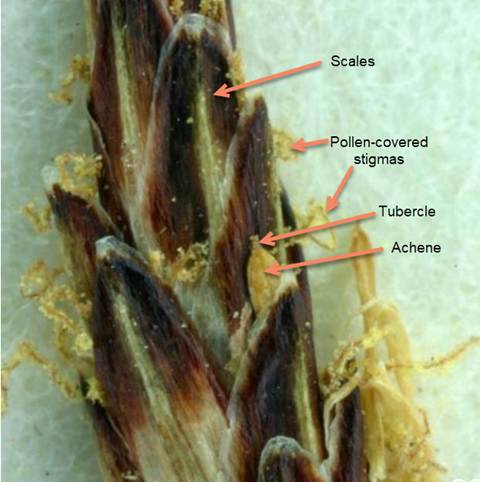
a rush. The flowers hide behind scales,
like a sedge, and are not six-parted like rushes.
A single spikelet
appears at the top of the stem. In
general, it’s a spiral of many scales, each covering a bisexual flower.
Parish’s Spike
Rush (Eleocharis parishii)
Photo by Steve
Matson
As with pine cones,
the scales cover developing flowers. When
mature, both male and female reproductive parts emerge from the scales. Fruiting seeds grow a distinctive cap, called
a tubercle.
These features are
pretty strange, so here are some more examples to help you get the idea.
|
Eleocharis obtusa Photo by Keir
Morse |
Eleocharis macrostachya Photo by
Wilde Legard |
|
Four Angled Spikerush spikelet Eleocharis
quadrangulata Photo by Steve Matson |
Four Angled Spikerush fruit Eleocharis quadrangulata Photo by Steve Matson |
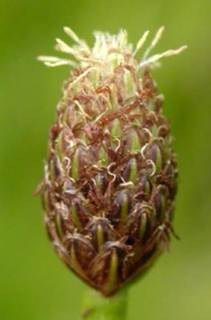
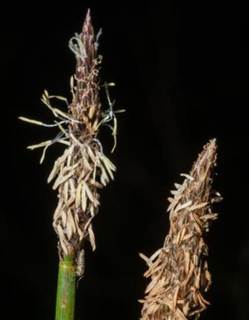
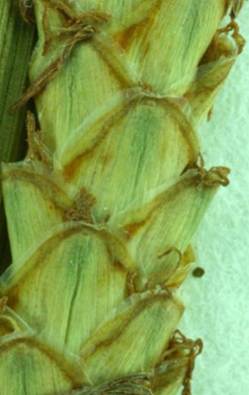
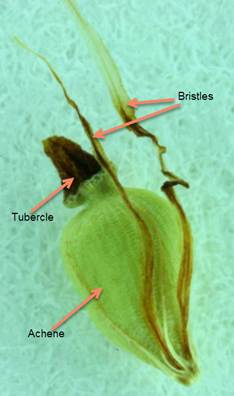
Notice that the
reproductive parts are quite naked when they emerge from their protective
scales.
Although there are
leaf sheaths at the base of stems, Spike Rushes have no leaf blades.
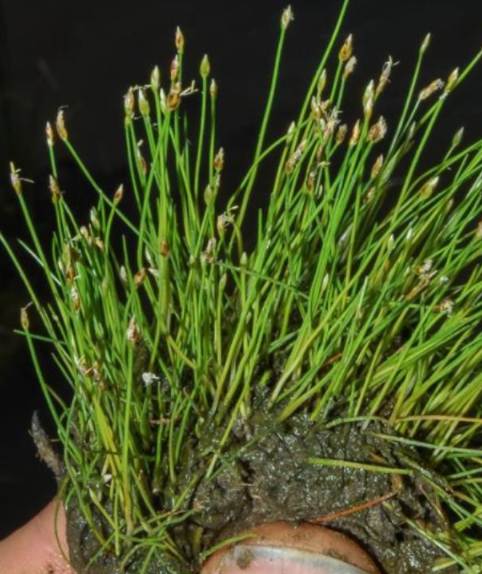
Small Spikerush (Eleocharis
parvula)
Photo by Wilde Legard
Every green stem you
see here ends up with a spikelet at the tip.
Schoenoplectus – Naked Stem Bulrush
This genus includes
two very large, common California marsh plants – California Bulrush and Tule.
Stems are round or
triangular, and often ribbed. This genus
has basal leaves, plus maybe one leaf along the stem. Leaf blades
exist, but they may be short.
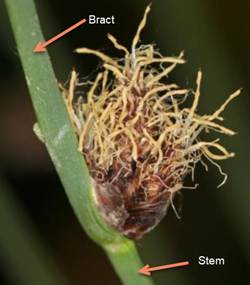
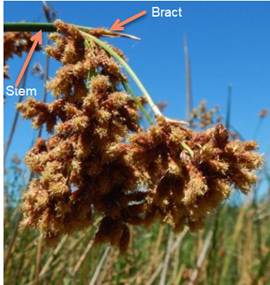
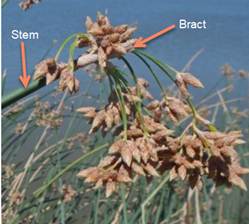
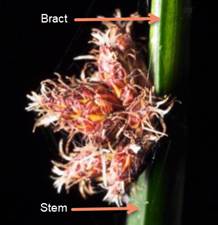
Inflorescences are made
up of spikelets of scaly flowers (not the 6-part flowers of rushes). The inflorescence is at the top of the stem, but
a stem-like bract extends beyond, giving the appearance of an inflorescence on
the side of the stem. Although stems are
often ribbed, the bract is smooth.
|
Schoenoplectus
pungens var. longispicatus Photo by Steve Matson |
Schoenoplectus
californicus Photo © Neal Kramer |
|
Common Tule Schoenoplectus
acutus var. occidentalis Photo © Neal Kramer |
Chairmaker’s Bulrush Schoenoplectus
americanus Photo by Keir Morse |
Want more?
Here’s an excellent,
detailed slideshow
about sedges:
Here’s a Genus Key to common California
Sedges and Rushes
|
|
Corrections/Comments:
bruce@PlantID.net Copyright:
https://PlantID.net/Contributors.aspx |