Grass Leaves (Sheath, Collar, Ligule, Blade, Inrolled)
Grass leaves have
three main parts – a sheath that
wraps around the stem, a collar that
connects the sheath to the leaf blade, and the leaf blade itself.
|
Photo
courtesy Zoya Akulova-Barlow |
|
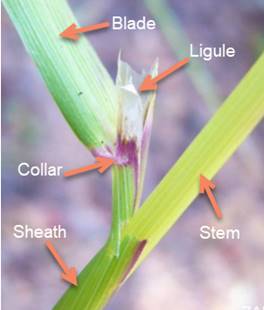
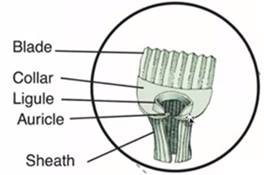
Each grass leaf
begins from the base of the stem or from a stem node. The leaf wraps around the stem, forming a sheath.
The new sheath is underneath older leaf sheaths, right next to the
stem.
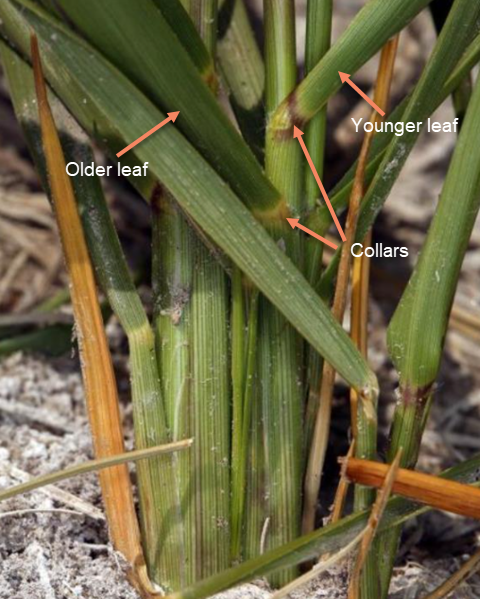
Alkali Cord Grass (Spartina
gracilis) Photo by Steve Matson
Leaf sheaths may be open, with their edges not connecting, or closed forming a complete tube around the stem.
|
A mostly closed
sheath:
California Brome (Bromus carinatus) Photo by Keir Morse |
An open sheath:
|
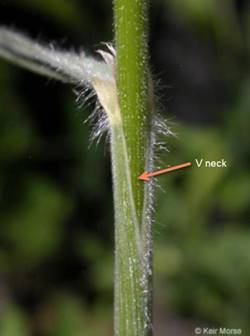
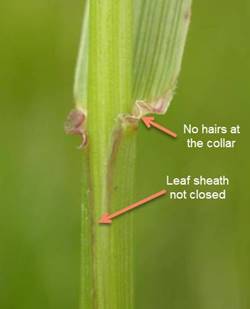
Cells at the top of
the sheath form a collar,
often easy to spot because it has a different color. The collar has specialized meristem cells. Meristem cells divide, growing a leaf blade
above the collar. This means that the blade tip is the
oldest part of a blade, and its base the newest. Other collar cells are
rigid, providing support for the blade.
A ligule grows at the junction of the sheath and blade – an extension of
the sheath. Ligules can be membranous,
hairy, or both. They can be so short
they’re hard to see, or up to ¾” long.
The ligule provides a seal between the sheath and stem, protecting the
stem below from insects, rain or dirt.
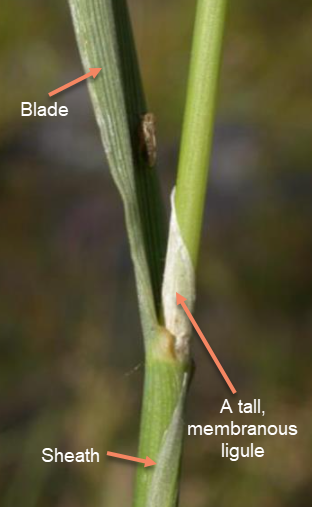
Annual Beard Grass (Polypogon
monspeliensis) – photo by Keir Morse
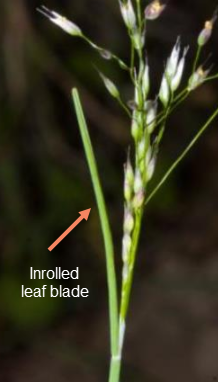
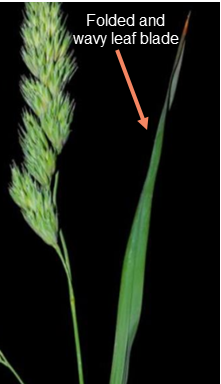
Leaf blades extend out from the stem,
starting at the collar. They can be flat, folded or inrolled (with the edges
curling upwards and sometimes joining to form a straw-like shape. Their edges can be wavy and/or hairy. Try running your finger along the edge, in
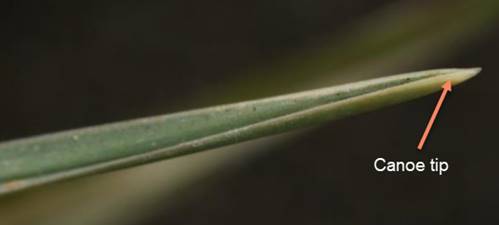
both directions, to test it for roughness. Leaf tips can be pointed, blunt, or
boat-shaped, like the tip of a canoe.
|
|
Orchard Grass
(Dactylis glomerata) |
Some grass-like
plants have a leaf sheath but no blade at all.
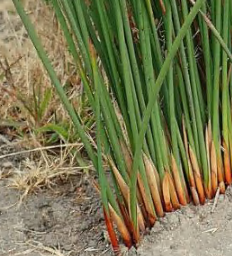
Spreading Rush (Juncus patens)
Photo © Neal Kramer
Here, leaf sheaths
start brown, turn pale, and then end without producing a blade.
Grass leaf blades do
the majority of photosynthesis. They
have parallel veins. They can continue
growing if eaten or damaged, as long as the meristem cells in the collar haven’t
been disturbed.
Vegetative grass
parts develop differently in each species, varying in shape, size and
color. For instance, a leaf sheath may be
open or closed. A ligule may be short or long, membranous or hairy. Blades may be narrow or wide, short or long,
pointed or round tipped.
Spend time with your
grass – there’s lots to learn about it.
Want more?
·
Jean
Turner’s excellent article on Grass
Identification.
·
Leaf
Formation by Oregon State University
|
|
Corrections/Comments:
bruce@PlantID.net Copyright:
https://PlantID.net/Contributors.aspx |