True Grasses
Family: Poaceae
Poaceae is the Grass Family. All True Grasses (as opposed to rushes and
sedges) belong to this family.
Tribes
The grass family is broken into tribes that
describe grass groups. Identifying a
grass to tribe is a good first step in learning about it. Here are the common California grass
tribes:
Bluegrass,
Oat, Brome,
Melic,
Wheat,
Needlegrass,
Reed,
Lovegrass,
Bermuda
Grass
Genera
Within the Grass Family, each type of grass is
assigned a scientific name, including genus and species.
Below are some of California’s common grass genera.
Click on one to learn more.
Agrostis
(Bent Grass)
Grow to 3 feet tall. Spikelets are small, flattened, and have
one floret. Glumes hide the floret.
|
|
|
|
|
Bromus
(Brome, Chess, Ripgut)
Branched inflorescence. Spikelets have several awned florets. Leaf sheaths end in a V-neck
|
|
Elymus (Wild Rye)
Spike inflorescence, often 2-ranked. Spikelets are flattened with 2 or more
florets. Frequently awned, with Medusa
Head and Big Squirrel Tail Grass awns several inches long. Perennial, except for Medusa Head.
|
|
Festuca (Fescue)
Branched inflorescence. Spikelets are long and narrow with several
florets each. Short awns. Leaf sheaths stay open. Many are weeds in California, but others are
classic California natives.
|
|
Hordeum (Barley)
A dense spike of fat spikelets with lots of
awns. Glumes are awn-like and florets
have awns. Natives include Squirrel
Tail and Meadow Barley. Non-natives
include Foxtail and Mediterranean Barley.
|
|
|
|
|
Melica
(Melic, Onion Grass)
Native, perennial bunch grasses. Generally, no awns. Cylindrical spikelets. Glume and floret edges are papery. Onion grass group has onion-like corms.
|
|
Phalaris
(Canary Grass)
Often appears as a spike although some species
open up at maturity and show their branches.
Shiny, wide, flat glumes hide a single fertile floret. No awns.
Wide, flat leaf blades are 6 – 20” long.
|
|
Poa
(Blue Grass)
Branched Inflorescence. Spikelets are small, 2-10 flowered. Laterally compressed. No awns.
Leaf blade with a groove on either side of the mid vein; leaf tip
often prow-shaped.
|
|
Stipa
(Needle Grass)
Bunch grasses with branched inflorescences. Spikelets have a single, membranous,
cylindrical floret, often with an awn.
Glumes are long enough to hide the floret.
|
|


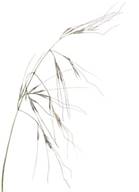
When you’ve read these articles, you’ll have lots to
look for when you meet a grass in the field.
Look at some grass genera from this page, and then
start digging into grasses in the group.
Have fun with it!
|
|
Corrections/Comments:
bruce@PlantID.net Copyright: https://PlantID.net/Contributors.aspx |
